Research
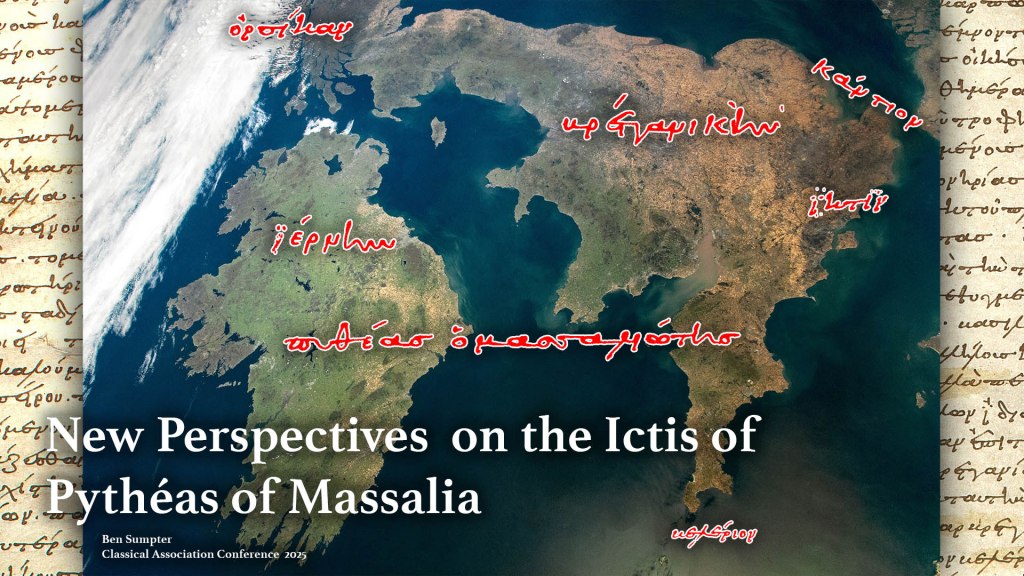
Ἴκτιν – or Ictis – features prominently in the earliest piece of written history concerning the British Isles, that of Pytheas of Massalia, dating from around 2300yrs ago. Ictis was the place were British tin was shipped before being sold to merchants and transported to the continent and mediterranean. A multidisciplinary study has been undertaken to evaluate the location of Ictis, the first since 1970, considering themes of toponymy, phonology, textual criticism, paleo-geomorphology and the classical disciplines. Critical analysis of Diodorus’ text reveal axioms by which to test evidence. The effects of Glacio-isostatic adjustment on steric sea level are considered for the first time, as well as new phonological and archaeological evidence. There is a strong agreement between independent sources that associate Ἴκτιν with the “Ουηκτίς” of Ptolemy, referring to the Isle of Wight. Diodorus’ inter-tidal criteria are found to match the geomorphology of the Wight hinterland, in particular Portsea, Hayling, Thorny and Selsea Islands. Wight’s central roll as a trading hub throughout history, including for metalliferous commodities, is considered in this context. The results of the paper aim to glimpse light on a two thousand year old mystery and propose questions for future studies.
Ἴκτιν – or Ictis – features prominently in the earliest piece of written history concerning the British Isles, that of Pytheas of Massalia, dating from around 2300yrs ago. Ictis was the place were British tin was shipped before being sold to merchants and transported to the continent and mediterranean. A multidisciplinary study has been undertaken to evaluate the location of Ictis, the first since 1970, considering themes of toponymy, phonology, textual criticism, paleo-geomorphology and the classical disciplines. Critical analysis of Diodorus’ text reveal axioms by which to test evidence. The effects of Glacio-isostatic adjustment on steric sea level are considered for the first time, as well as new phonological and archaeological evidence. There is a strong agreement between independent sources that associate Ἴκτιν with the “Ουηκτίς” of Ptolemy, referring to the Isle of Wight. Diodorus’ inter-tidal criteria are found to match the geomorphology of the Wight hinterland, in particular Portsea, Hayling, Thorny and Selsea Islands. Wight’s central roll as a trading hub throughout history, including for metalliferous commodities, is considered in this context. The results of the paper aim to glimpse light on a two thousand year old mystery and propose questions for future studies.
Click here to download the draft working paper.
 The Kassiteros Project